informing code & policy:
The utilization of xr for the visualization of carceral environment standards
Abstract:
This paper proposes that eXtended Reality (XR) visualizations of standardized prison cells can measurably shift public attitudes toward more empathetic and reform-oriented views of carceral conditions and the related architectural codes and policies that dictate space. Drawing on the historic evolution of U.S. prison design standards, particularly focusing on the American Correctional Association’s post 90’s single-occupancy cell requirements, this paper argues that current regulatory frameworks neglect the psychological and spatial realities of confinement, despite professed commitments to humanity and rehabilitation.
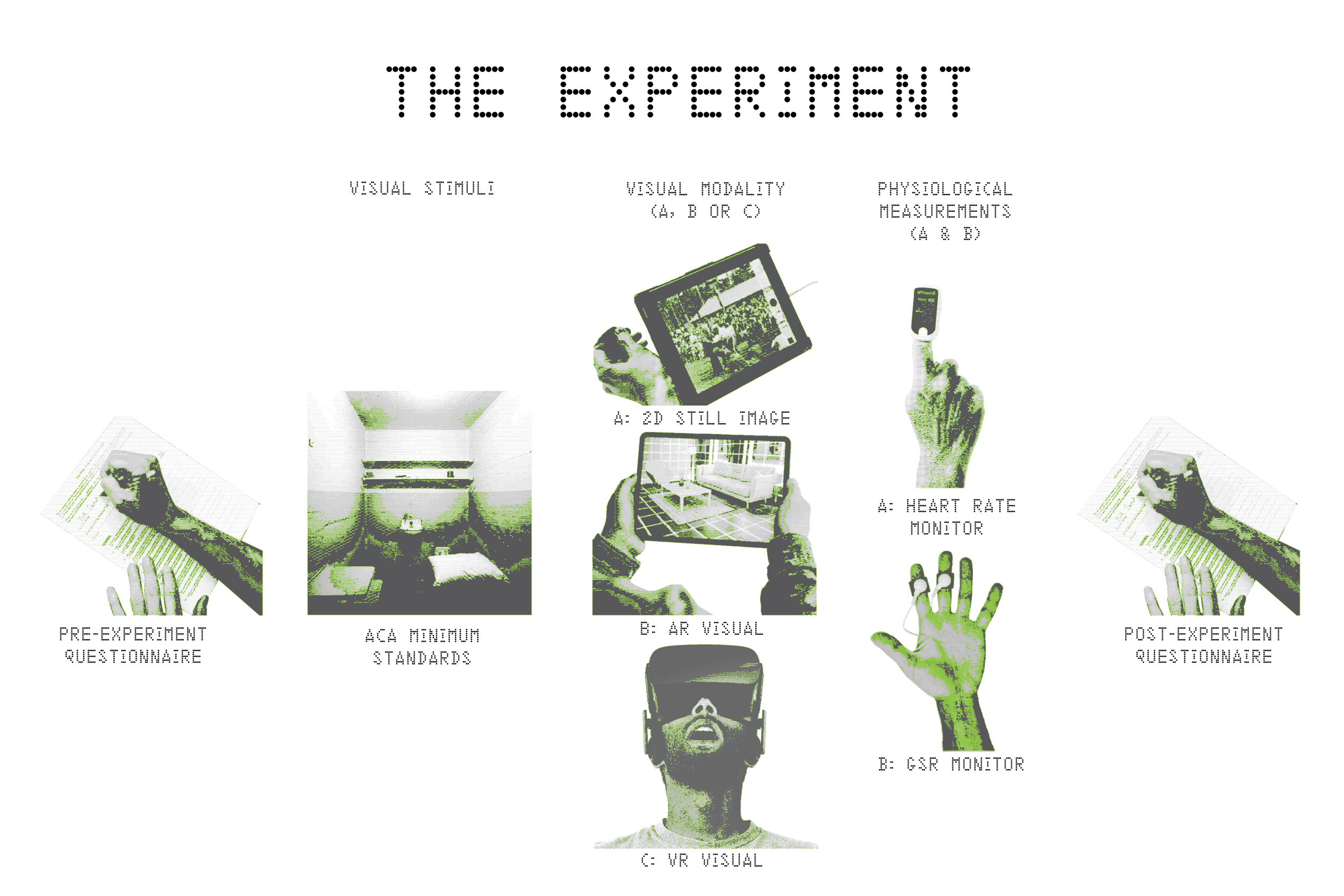
To test XR’s potential as an “empathy machine” for carceral space, this paper outlines an experimental design in which participants, stratified by political ideology, are randomly assigned to one of the three visualization modalities. Participants will view a BIM modeled ACA compliant single occupancy cell through still 2D imagery, tablet-based Augmented Reality (AR), or head-mounted Virtual Reality (VR). Following the visualization, participants will then complete a modified Attitudes Toward Prisoners (ATP) scale with added architectural specific items. Physiological measurements indicating arousal (heart rate and skin conductance) will be collected during the exposure of visual stimuli to assess whether more immersive modalities generate stronger emotional responses, as well as create a larger shift in pre/post attitudinal measurements. Combined, the results of the experiment should highlight whether baseline views on the carceral environment or ideological predispositions have an effect toward physiological responses in different modalities of visual stimuli, as well as measurable level of attitudinal shift.
While not yet tested, the project contends that positive findings could position XR as a practical tool for architects, policymakers, and abolitionist advocates to interrogate the spatial consequences of current carceral codes and policies. The project seeks to aid and inform evidence-based revisions of the current minimum standards, while simultaneously extending XR’s civic applications beyond the current research trajectory of urban planning and climate change.